China’s comprehensive solar exploration satellite "Kuafu I" was successfully launched.
CCTV News:At 7: 43 Beijing time on October 9, 2022, China successfully launched the advanced space-based solar observatory (nicknamed "Kuafu I") satellite by using the Long March II carrier rocket at Jiuquan Satellite Launch Center. The satellite successfully entered the scheduled orbit and the launch mission was a complete success.

The satellite is mainly used to study the causal relationship between solar flare burst, coronal mass ejection and solar magnetic field, and provide data support for space weather forecast. This mission is the 442nd flight of the Long March series of launch vehicles.
The Advanced Space-based Solar Observatory is a comprehensive special satellite for solar exploration independently proposed by China solar physicists, and it is another space science satellite developed and launched by the space science pilot project of China Academy of Sciences after Wukong, Mozi, Huiyan, Shijian No.10, Taiji No.1 and Huairou No.1.. The successful launch of this satellite has achieved a leap-forward breakthrough in China’s space-based solar exploration satellite.
Solar activity is periodic, with a period of every 11 years, from 2024— 2025 will usher in the next peak of solar activity. The advanced space-based solar observatory will take advantage of the opportunity of the 25th peak year of solar activity to carry out observation with "one magnetic field and two storms" as the scientific goal. "One magnetism" is the solar magnetic field, and "two storms" are the two most violent explosion phenomena on the sun — — Solar flares and coronal mass ejections. The satellite will study the formation, evolution, interaction and correlation of "one magnetic field and two storms", and provide support for space disastrous weather forecast that affects high-tech activities such as human spaceflight, communication and navigation.
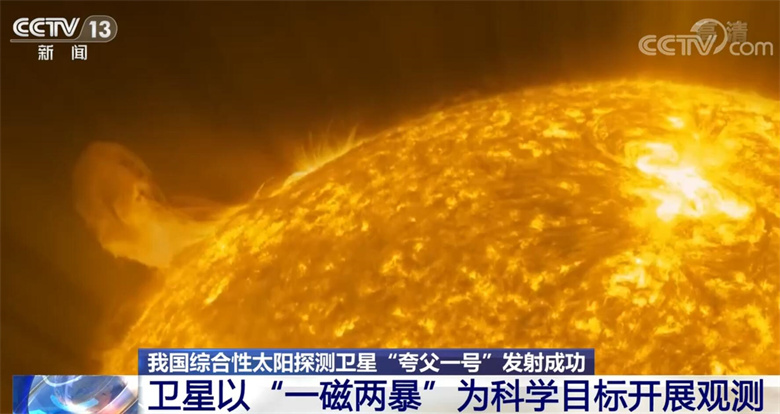
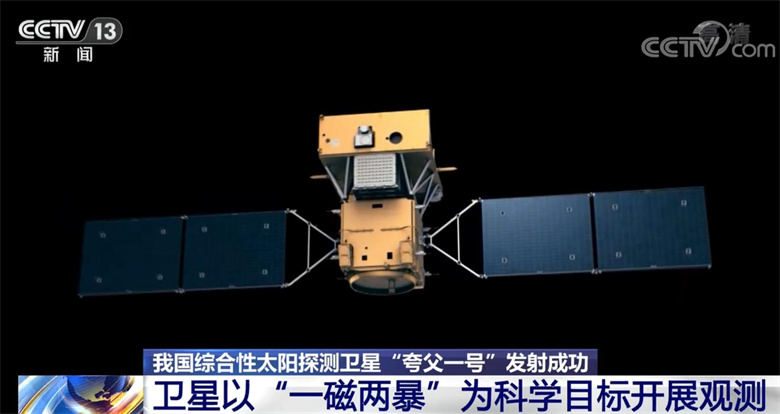
It is understood that the advanced space-based solar observatory is equipped with three payloads, namely, the all-day vector magnetic imager, the Lyman Alpha solar telescope and the solar hard X-ray imager. The three loads cooperate with each other, which can realize the simultaneous observation of solar magnetic field, non-thermal radiation of solar flare, solar surface formation and near-surface propagation of coronal mass ejection on a near-earth satellite platform. With the help of Lyman Alpha Solar Telescope, scientists will observe the whole solar surface and the recent corona simultaneously in Lyman Alpha band for the first time. The satellite has a design life of 4 years and runs in a sun-synchronous morning and evening orbit about 720 kilometers from the ground.
Gan Weiqun, Chief Scientist of Advanced Space-based Solar Observatory;After the satellite launch, we plan to carry out a series of international cooperation. We plan to conduct an international training to tell our international counterparts how to use our data and download our data, including how to use our software. After the on-orbit test, all our data, including software, will be opened to international counterparts in time to jointly achieve the scientific goals of our satellite.