After talking with 10 authoritative people who participated in the planning, I found opportunities in the future.
Remember a popular saying last year?
Human history will be divided into before 2020 and after 2020.
After crossing the "tunnel" in 2020, the world seems to see the light. According to the latest forecast of the United Nations, global economic growth this year is expected to offset last year’s losses.
But there is a premise that the epidemic situation is properly controlled and the vaccine is widely vaccinated.
In 2021, there are opportunities, but opportunities are complicated.
This complexity is intuitive in the Economist’s prediction.
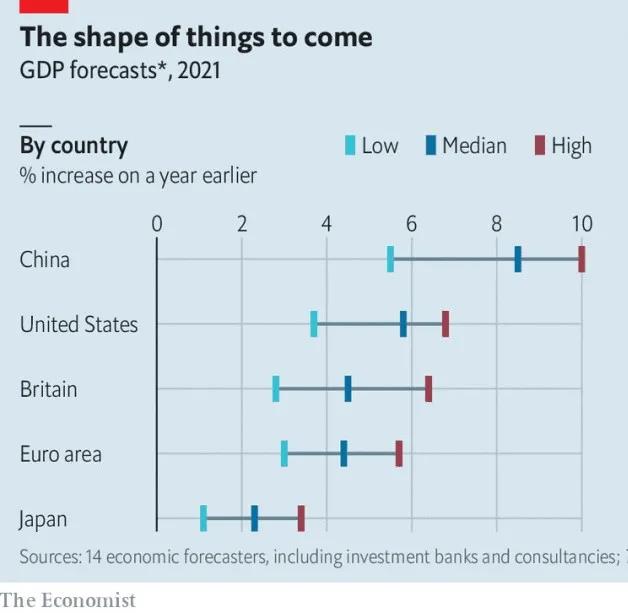
▲ Forecast of GDP growth rate of major global economies in 2021.
The economic growth rate of major economies in the world is in a large fluctuation range.
In 2021, for the world, there is great uncertainty. For China, it is of special significance and far-reaching.
The year 2021 is the connecting point of the goal of "two hundred years", the relay point of two five-year plans and the starting line of the fifteen-year vision.
These particularities are all condensed in a booklet of more than 60,000 words.
On March 13th, the outline of the 14th Five-Year Plan was published in full.
If you are 25 years old this year, this outline is related to your 30 years old and 40 years old. What do you think of the opportunities?
Tan found 10 "insiders" to chat and found some clues between the lines.

Looking at the plan, we must first look at the goal.
Economic growth index is the focus of attention, but it is rare that the "14 th Five-Year Plan" does not set economic growth index.
Why is this design? We can see some clues from the beginning of the 14 th Five-Year Plan this year.
There is no clear target value for economic growth in 2021, but only a range — — More than 6%.
This means that we have only drawn a bottom line.

▲2021 "Government Work Report"
How to understand this profound meaning? In the communication with Yang Weimin, he gave Tan a key interpretation of a word — — Employment.
Yang Weimin is a senior "planner". As early as the 11th Five-Year Plan, he worked in the Planning Department of the National Development and Reform Commission.
This institution is the main functional department for the preparation of the five-year plan.
Following Yang Weimin’s tips, we can find that the employment target of 11 million people has been set this year.
From the perspective of GDP accounting method, he analyzed the relationship between employment and economic growth for Tan Zhu:
There are three methods of GDP accounting, namely, production method, income method and expenditure method. From the perspective of income, assuming that these 11 million people are employed, how much their income will increase each year and how much it accounts for GDP can be directly calculated.
Economic growth can lead to an increase in employment, and vice versa. Employment, for everyone, is a real growth.
Draw the bottom line for the economy. Above the bottom line, people are more important.
Through the outline of the 14 th Five-Year Plan, the context of the bottom line thinking is clearly visible.
From the two "firsts" among the 20 indicators, we can also see clues.
For the first time, the "safety and security" index was set up, and the comprehensive production capacity of grain and energy was included in the plan.

Another first is the largest number of binding indicators in the planning — — Green ecology.

Binding means that it must be completed.
How to measure these indicators?
Liu Chunyu, director of the Urban-Rural Integration Development Division of the Planning Department of the National Development and Reform Commission, gave Tan Zhu two figurative metaphors: "from far to near" and "jumping and touching".
He explained:
In some aspects, the target value in 2035 has been determined, so as to reverse the target during the 14 th Five-Year Plan period; Others follow the principles of seeking truth from facts, being scientific and reasonable, doing their best and doing what they can, and set the goal of "jumping and touching".
The word "jump" shows initiative and determination.
Wang Jinnan, dean of the Environmental Planning Institute of the Ministry of Ecology and Environment, is also deeply touched by this.
Wang Jinnan, an academician of China Academy of Engineering, presided over the completion of the national "Eleventh Five-Year Plan" to "Thirteenth Five-Year Plan" on environmental protection. An incident last year impressed him deeply.
In his speech at the general debate of the 75th United Nations General Assembly, the Chairman of the Supreme Leader made it clear that China’s carbon dioxide emissions should reach the peak by 2030 and be carbon neutral by 2060.
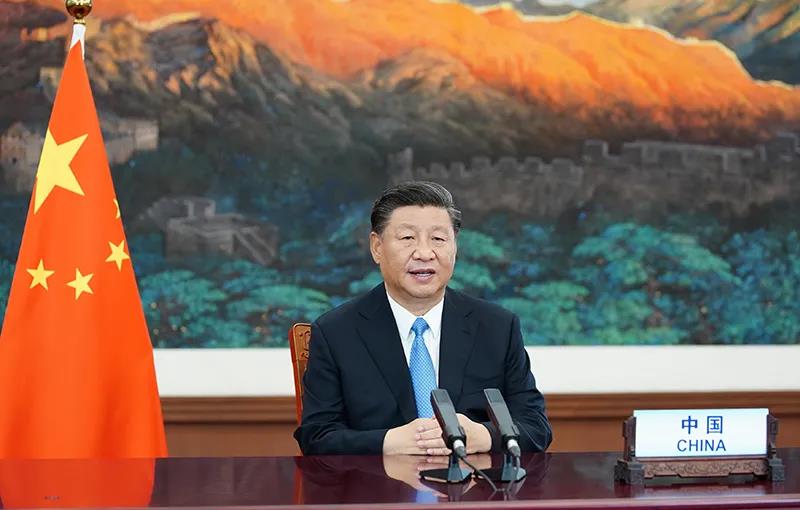
You know, the time from peak carbon dioxide emissions to carbon neutrality in developed countries is 40 -60 years. China proposed that it only takes 30 years.
This has attracted worldwide attention.
Wang Jinnan told Tan Zhu:
Before that, at the policy level, only the goal of peak carbon dioxide emissions was mentioned, and the goal of carbon neutrality was never mentioned. Most of the related research spans only reach 2050, but not beyond 2060.
The words of General Secretary of the Supreme Leader show the "green" determination, shape and new development opportunities. The strategy of peak carbon dioxide emissions and carbon neutrality will be comprehensive, which will force the economic restructuring.
Clean energy is an outlet. According to Goldman Sachs’ prediction, by 2060, the investment scale of clean energy infrastructure in China will reach one trillion, and the net increase of jobs will be 40 million.

Who can take the lead?
The data shows that the area with the highest installed capacity of wind power and solar power in China is in the Three North — — Northwest, northeast and north China, and the growth momentum is not diminished.
Green development may become the driving force for the northern breakthrough.
The layout of China’s northern and southern cities also contains new opportunities.

During the two sessions this year, Cai Jiming, deputy to the National People’s Congress, had a dialogue with the vice mayor of Shenzhen.
Cai Jiming’s first question hit the nail on the head — — How much difference does it make in Shenzhen whether you have a hukou or not?
For many new urban residents, hukou is the last mile to settle down, which involves employment, medical care, social security, children’s education and even retirement.
Cai Jiming, as a member of the expert committee of the 14th Five-Year Plan, is most concerned about how to get through the last mile.
Two indicators are crucial — — Urbanization rate of permanent population and urbanization rate of registered population. The former counts people who have lived in the city for more than 6 months, while the latter counts people with hukou.
In 2013, the urbanization rate of registered population in China was only 35.93%, and by 2019, this figure has become 44.38%. This means that more than 100 million agricultural migrants have settled in cities.
But in 2019, the urbanization rate of permanent residents was 60.6%. This means that there are still about 230 million people in the city, but they have not settled down.
Settle down is the concern of many people, and it is also the goal of many jobs in the past, but Cai Jiming told Tan Zhu that there is no target for the urbanization rate of registered population in the "14th Five-Year Plan".
What does this mean? Shenzhen, maybe you can provide a sample.

Wu Yihuan, vice mayor of Shenzhen, said that for people living in Shenzhen, there is only 20% difference, and 80% of basic public services are the same. This reminds Tan of a familiar slogan — — You are from Shenzhen when you come.
It is more important to say that public services related to hukou are the key than hukou.
If you look closely at the Tenth Five-Year Plan, you will find that in the chapter of urbanization, many expressions have slight changes. In the chapter of "accelerating the urbanization of agricultural transfer population":
"Promoting more people to integrate into cities and towns" has become "accelerating the full integration of agricultural transfer population into cities".
According to Cai Jiming’s analysis, in the future, the hukou itself will not be discussed blindly, but the related services will be realized one by one.
This sentence in the plan is clearly written:
According to the actual situation of population flow, adjust the staffing quota of teachers and doctors and the layout of basic public service facilities in the inflow and outflow areas.
This means letting resources follow people.

Population, where are they all flowing?
In 2020, the ten cities with the largest net population inflow in China are:
Shanghai, Shenzhen, Beijing, Dongguan, Guangzhou, Tianjin, Foshan, Suzhou, Ningbo and Hangzhou.
What on earth does a city attract people? Master Tan also made a survey:
This is not only a small layout of the city, but also a big layout of the country. Fan Jie knows this layout very well.
Since the establishment of the Expert Committee in the Eleventh Five-Year Plan, he has participated in the planning for four times in a row, and he has also participated in the planning of the Beijing-Tianjin-Hebei and Pearl River Delta metropolitan areas.
Fan Jie told Tan Master:
The key to coordination is to solve the imbalance of economic development. If GDP per capita is taken as an indicator, we should not only optimize the numerator and improve the economic level of backward areas, but also adjust the denominator, conform to the law, guide the rational flow of population, and make the future population distribution match the spatial distribution of national resources and environment.
What do you think of the spatial layout of China?
Fan Jie shared an article "Seeking Truth" with Tan Zhu: "Promoting the Formation of Regional Economic Layout with Complementary Advantages and High-quality Development".
The article is part of the speech made by the Supreme Leader General Secretary at the fifth meeting of the Central Financial and Economic Committee. Although it is only a part, it is enough to see the richer connotation of the word "coordination" in the new era:
We should not simply ask all regions to reach the same level in economic development, but take the road of rational division of labor and optimized development according to the conditions of each region.
Give full play to comparative advantages, promote regional cooperation, refine the division of functional areas and maximize the overall interests of the country. This is the dialectics of "coordination".
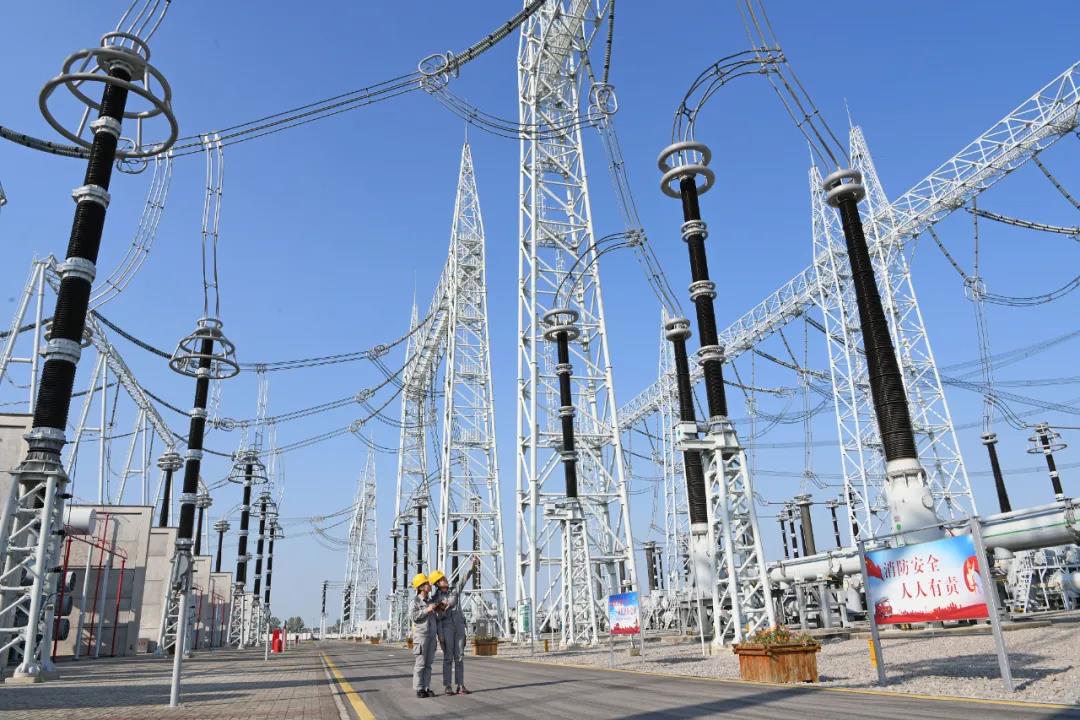
▲ In 2013, Huainan, Anhui Province, the 1000 kV high-voltage Huainan substation was put into use.
Fan Jie’s participation in the preparation of the 14 th Five-Year Plan still has a great feeling:
The level of people-centered coordination is not limited to the quality level determined by economic income, but also includes the level of social service facilities and the quality level of local ecological environment.
The connotation of high-quality development is here.
With a harmonious "background color", the flow between cities and townships, between cities and between regions contains the code of China’s development and new opportunities for all.

The world is also sharing opportunities in China.
Just before the two sessions, Eurostat released the trade data in 2020, and China surpassed the United States for the first time to become the largest trading partner of the EU.
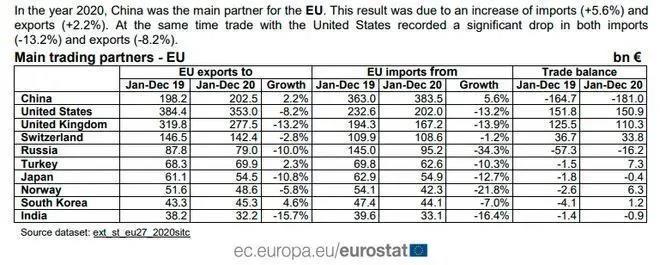
▲ In 2020, China will become the main trading partner of the European Union, because the EU’s imports (+5.6%) and exports (+2.2%) to China have increased, while its trade imports (-13.2%) and exports (-8.2%) to the United States have dropped sharply.
What’s more worth mentioning is that China is the only one among the top ten goods trading partners of the European Union to achieve two-way trade growth.
This is the only one, and the goods are really worth it.
Since June 2020, China’s foreign trade has achieved positive growth for nine consecutive months. In 2020, the total value of imports, exports and exports reached record highs, making it the only major economy in the world to achieve positive growth in goods trade.
Made in China, serving the whole world.
In this regard, one person’s experience is particularly different. She is Zhang Qiao from the Planning Department of the National Development and Reform Commission, and participated in the writing of the first draft of the 14th Five-Year Plan.
The chapter she wrote is unprecedented in the previous planning, and it is called "forming a strong domestic market and building a new development pattern".
Based on the new development stage, implementing the new development concept and building a new development pattern are the basic coordinates for China to face the future.
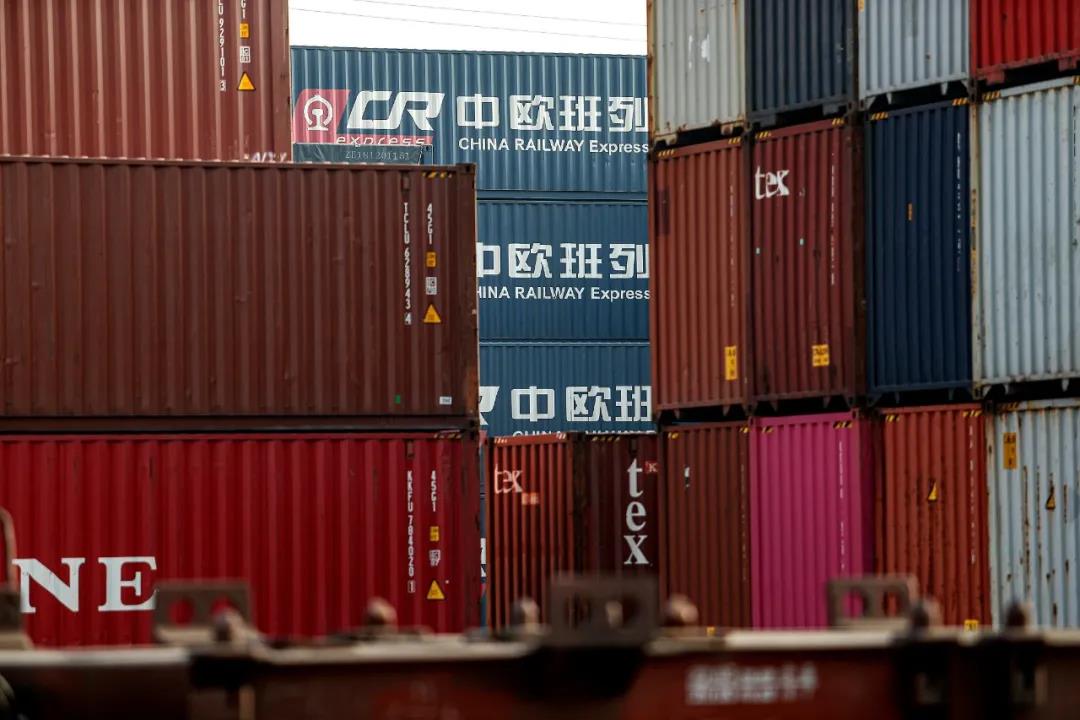
The opportunities contained in the new development pattern are also rich.
The epidemic situation once interrupted the global industrial chain supply chain, and some countries tried to make the manufacturing industry return, which accelerated the trend of closure. China relied on its strong internal strength — — The world’s complete industrial system has stabilized the world’s supply.
But in fact, before 2020, the proportion of China’s manufacturing industry’s added value to GDP has been showing a downward trend.
In 2019, the proportion was only 27%, reaching the lowest level since 2012.
This trend changed in 2020.
Zhou Hao, an economist at the German Commercial Bank, published an article on China’s economy during the two sessions, entitled "Friends of Trends".
Zhou Hao told Tan Master:
Manufacturing industry has greater certainty, and one of the trends in the post-epidemic era is the return of manufacturing industry.

▲ Zhou Hao’s description of the manufacturing industry in the article "Friends of Trends"
Liu Yuanchun’s judgment is basically the same. As the vice president of China Renmin University, Liu Yuanchun’s understanding is more attractive to young people:
Future employment may present a phenomenon of "middle hole". On the one hand, it is innovative and high-tech personnel, on the other hand, it is experiential service personnel. There will be more people at both ends, and there may be fewer traditional technicians in the middle. Because the manufacturing industry is developing towards high-end, intelligent and digital.
Looking at the five-year plan, the change of the trend has already been hidden.
In the "Thirteenth Five-Year Plan", the expression of the real economy is "consolidating the foundation of the real economy".
In the Tenth Five-Year Plan, it became "insisting on focusing on the real economy".
The most striking thing is that there is another data.
This year, the central government’s basic research expenditure will increase by 10.6%.
Huang Qunhui, director of the Institute of Economics of the Chinese Academy of Social Sciences, told Tan Zhu:
At present, the proportion of China’s total social R&D investment in GDP is roughly equal to that of the EU. However, the proportion of basic research in R&D investment is too low, just over 6%, and the proportion of major innovative countries in the world is mostly above 15%.
This also has a special new section in the 14 th Five-Year Plan — — Persevere in strengthening basic research, and there is a special new article — — Accelerate the development of digitalization and build a digital China.
In the future, the manufacturing industry will be stronger and contain more gold. But the gold content takes a long time to work.
Tan Zhu remembered the words of Zhou Yumei, a researcher at the Institute of Microelectronics, Chinese Academy of Sciences, on the channel of members of the two sessions this year:
Integrated Circuit is the Long March for Practitioners … … It is hoped that more outstanding talents will devote themselves to the integrated circuit industry, and more outstanding students will apply for the integrated circuit major.
Five years is the time coordinate.
We can’t predict how many surprises there will be in five years, but the intersection of national planning and personal goals remains the same, that is, to live in peace and contentment.
Layout is a spatial coordinate.
The goal is never just to complete a task at a certain time. The national planning spectrum is a blueprint for everyone to move freely. You can find a new way in the countryside and shine in the city.
People are the purpose of development.
The most important indicator in the 14th Five-Year Plan is people’s livelihood security, and everyone is creating value as well as value itself.
In the face of the opportunity of the times, China has chosen to cultivate internal strength and take advantage of the situation. You, are you ready?