Urban and rural construction: how to strengthen the protection and inheritance of historical culture
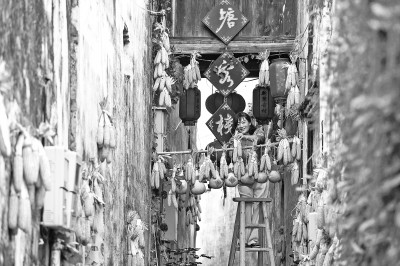
Villagers hang corn in the alley of Xinyegu Village, Daciyan Town, Jiande, Zhejiang Province. Xinhua news agency
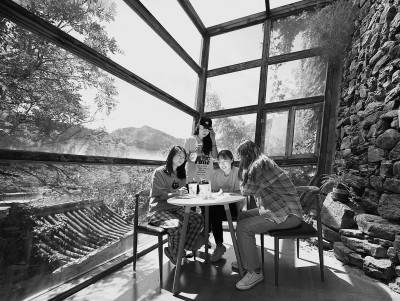
Tourists drink coffee in a cafe in Lujia Village, Nanzhang Town, Jingxing County, Shijiazhuang, Hebei Province. Xinhua news agency
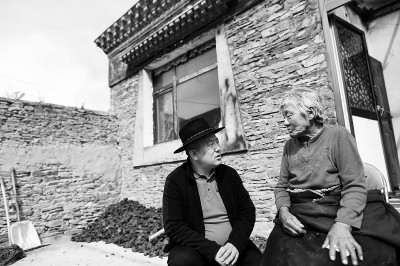
In Guowu Village, Labu Township, Chengduo County, Yushu Prefecture, Qinghai Province, Nima (left) plans to help restore the traditional buildings of villagers’ homes. Xinhua news agency
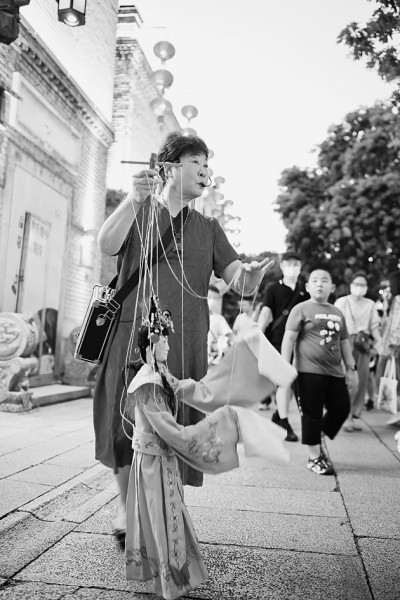
Artists perform marionettes in Nanhou Street, a historical and cultural block of Sanfangqixiang, Fuzhou, Fujian. Xinhua news agency
History is the carrier of culture, and culture is the blood of history. After five thousand years of vicissitudes, Chinese civilization has always come down in one continuous line, which is precisely because the historical and cultural heritage of splendid civilization has a long history and is surging forward.
"Literary movement is linked with national movement, and cultural context is linked with national vein". For a long time, China’s history and culture have been preserved in various ways in urban and rural areas, precipitated into unique memories and signs, and played an irreplaceable role in each period. A few days ago, the general offices of the General Office of the Central Committee of the CPC and the State Council issued the Opinions on Strengthening the Protection and Inheritance of Historical Culture in Urban and Rural Construction (hereinafter referred to as the Opinions), which clearly proposed to establish an urban and rural historical and cultural protection and inheritance system with scientific classification, strong protection and effective management, which pointed out the direction and provided guidance for the next step.
Nowadays, when old traditions meet new ideas and ancient buildings meet new technologies, how to further strengthen the protection and inheritance of historical and cultural heritage and continue to inherit the historical context and cultural foundation has become a brand-new topic that the whole society has to face.
1. "Non-legacy+tourism" makes ancient villages "live"
● Case: Ancient Cinnamomum camphora forest, blue bricks and black tiles, deep courtyard, hookah curling … … During the National Day holiday this year, Diaoyuan Ancient Village, located in Xingqiao Town, Jizhou District, Ji ‘an, Jiangxi Province, became the travel destination of Li Juan, a freshman of Nanchang University, and his roommates.
Diaoyuan Ancient Village is an ancient village with a history of more than 1100 years. Walking into the village, the patchwork of residential shrines, mottled old wind and fire walls, winding alleys and other landscapes all reveal strong humanistic colors. "I have long heard that the ancient fishing village is beautiful, but I didn’t feel what ‘ A blue brick and black tile ink painting ’ 。” Li Juan said.
It is understood that in recent years, after the establishment of the new village, the ancient village of Diaoyuan has shown a trend of "hollowing out", leaving only a few families. In order to solve the problem of protection and rational utilization of hollow villages and ancient buildings, Jizhou District has introduced high-quality planning from professional teams, and transformed and upgraded the entrance experience area, post road experience area, future village experimental field, ancient village ancient rhyme area, ancient village source area and ancient village merchant area, so that traditional ancient villages can be truly "alive".
In recent years, in the domestic tourism market, ancient village tourism, which can enjoy both natural beauty and historical and cultural charm, has been favored by more and more "donkey friends".
"In the context of consumption upgrading and limited travel abroad, the main distribution areas of ancient villages and towns in China, such as Jiangxi and Anhui, have ushered in a golden opportunity period for the development of cultural tourism." Guo Xiaoguang, director of the Industrial Development Department of the Special Committee of Ancient Villages and Towns of China Cultural Relics Society, said, however, some ancient villages, as cultural relics, have strict standards in planning, development, commercial operation and so on, which are far higher than those of ordinary cultural tourism projects. How to play a good card of the integration of Zhang Wen and Lu on the premise of cultural relics protection has become a new topic for all localities, especially in the resource-rich areas of ancient villages and towns.
Jingxian County, Xuancheng, Anhui Province, located in the south of Anhui Province, is a tourist destination with 25 ancient villages and towns listed in the list of traditional Chinese villages. In recent years, with the spread of new media such as short videos, the number of tourists and tourism income here have been rising year after year, and the living standards of local residents have been significantly improved.
"Although tourism resources are sufficient, the legal system related to ancient villages and towns is still not perfect, and it is difficult to carry out protection work in ancient villages and towns." The relevant person in charge of the Jingxian Cultural Relics Bureau said that not only is the pressure on the protection of ancient buildings huge, but the contradiction between the villagers’ housing needs and the protection of ancient buildings is prominent because the ancient buildings cannot meet the living standards of modern people in hardware conditions.
"Although the cultural tourism of ancient villages has achieved certain results, problems such as the disappearance of ancient villages are equally prominent. After the reform and opening up, the speed of destruction and extinction of ancient villages in China has accelerated. " The relevant person in charge of the Prospective Industry Research Institute said that although the country is gradually increasing the statutory protection of famous historical and cultural cities, towns and villages, various localities still face many difficulties in implementing protection, repair and activation.
In this regard, the Opinions clearly pointed out that living heritages such as cities, villages and towns should be the main body and rely on, and various historical and cultural heritages such as historical and cultural cities, towns and villages (traditional villages), blocks and historical buildings, industrial heritage, agricultural cultural heritage and intangible cultural heritage should be taken as an organic whole to form a protection and inheritance system.
The data shows that up to now, China has 137 national historical and cultural cities and 190 provincial historical and cultural cities. At the same time, China has also announced 312 famous historical and cultural towns in China, 487 famous historical and cultural villages in China and 6819 traditional villages in China, forming the largest agricultural civilization heritage group in the world so far.
"Historical and cultural cities, towns and villages, including historical blocks and historical buildings, are important carriers of production and life, and the protection and inheritance work is closely related to the daily life of ordinary people." Su Yunshan, director of the Department of Building Energy Conservation and Science and Technology of the Ministry of Housing and Urban-Rural Development, said that it is necessary to give full play to the comprehensive value of cultural heritage, integrate scattered historical and cultural resources, and let the masses ‘ Daily use without feeling ’ Feel the charm of culture; It is also necessary to develop cultural tourism and creative industries, so that ordinary people can get tangible benefits and have more sense of gain.
2. "Development+Protection" of modern architecture should be paid attention to.
● Cases: Bund complex, Xujiahui Catholic Church, Jing ‘an Temple … … Shanghai is one of the most prosperous cities in China and the birthplace and development center of modern architectural culture in China.
However, in the process of urban development, Shanghai has a slow understanding of the protection of architectural cultural heritage. After nearly 30 years of exploration, Shanghai has carried out exploratory experiments in repairing, adding, shifting, inserting and rebuilding, style protection, renewal, regeneration and utilization of historical buildings, and formed a mechanism and method for protecting architectural cultural heritage that basically conforms to the characteristics and reality of Shanghai’s historical buildings.
History and culture are the soul of a city. How to deal with the relationship between urban reconstruction and development and the protection and utilization of historical and cultural heritage is an important issue facing urban development in China.
"The nearly 23 million square meters of Lane House built from the end of 19th century to 1930s is the most distinctive architectural type in Shanghai, and it is a typical blend of Chinese and Western architectural forms and lifestyles." Zheng Shiling, an academician of China Academy of Sciences and a professor of college of architecture and urban planning, pointed out that from 1980s to the mid-1990s, "change" and "new" became synonymous with urban development, and simply aimed at "new" and "change", lacking institutional guarantee in the aspects of legal system, management and operation.
According to the data, up to now, about two-thirds of the 45 million square meters of historical buildings left over from Shanghai’s history no longer exist, and less than 1,000 of the 9,214 articles counted in 1949 are left.
However, with the increasing awareness of the inheritance and protection of historical and cultural heritage, great achievements have been made in the protection of architectural cultural heritage in Shanghai since 2002, and a suitable protection model for Shanghai has also been preliminarily explored, that is, insisting on the combination of use and protection and protecting in use. Zheng Shiling said that a number of excellent examples have emerged by implanting various functions in historical buildings, such as using historical office, residential and public buildings as clubs and schools, and using industrial architectural heritage as creative centers, residences, hotels and theaters.
"The" Opinions "clearly stated that it is necessary to establish an urban and rural historical and cultural protection and inheritance system with scientific classification, strong protection and effective management." Yang Baojun, chief economist of the Ministry of Housing and Urban-Rural Development, pointed out that this requires us to protect not only single buildings, but also streets and towns, as well as historical sites, natural landscapes, humanistic environment and intangible cultural heritage.
In addition, in the past historical and cultural protection work, there was a tendency to attach importance to ancient times and despise modern times, and ancient China and modern China could not be truly, stereoscopically and comprehensively displayed. In view of this problem, the Opinions put forward that we should not only protect the ancient heritage of China, but also protect the important achievements of modern and contemporary construction.
"It is necessary to systematically protect the historical and cultural heritage of each period, comprehensively show the ancient civilization and modern history, especially the glorious course of the founding of the Communist Party of China (CPC), the founding of New China, and the reform and opening up, and tell the story of China vividly and three-dimensionally." Yang Baojun said.
Strict demolition management is the key to the protection and inheritance of urban and rural history and culture. In this regard, the "Opinions" clearly stated that "it is forbidden to demolish large buildings, demolish the real ones, and confuse the fake ones with the real ones in urban renewal" and "effectively protect the existing buildings that can reflect the specific development stage of the city, reflect important historical events, and condense the emotional memory of the public". These measures will have a far-reaching impact on the protection and inheritance of historical culture.
3. "Science and technology+inheritance" creates a new way to protect cultural heritage.
● Case: Recently, the 2021 Cultural Heritage Digital UAV Close to Photogrammetry Competition was officially launched. The activity collected and selected the fine model of cultural heritage presented by UAV close to photogrammetry technology online, aiming at promoting the digital protection of chinese heritage, exploring new methods and paths of "three-dimensional real scene" construction, and promoting China’s excellent history and culture.
The surveying and mapping objects of the works collected in this competition are China’s traditional material and cultural heritage, including ancient sites, ancient buildings, ancient villages, cave temples, stone carvings, murals, important modern historical sites or representative buildings, and historical and cultural cities with outstanding value in architectural style, distribution or combination with environmental scenery.
It is understood that "close to photogrammetry" is a brand-new technology put forward by the team of Academician Zhang Zuxun of Wuhan University to meet the demand of fine surveying in surveying and mapping industry. It was first applied to geological survey and monitoring and early warning, taking the "face" of an object as the object of photography, obtaining ultra-high resolution images through close photography, and finely extracting geographic information.
"UAV close to photogrammetry technology can record ancient buildings and cultural sites at high speed and in all directions, which can not only improve the efficiency of data collection of cultural heritage surveying and mapping, but also greatly reduce the safety risks during operation." The relevant person in charge of DJI Innovation Technology Co., Ltd. said that with this technology, cultural relics protection workers can easily restore the true face of ancient buildings and provide data support for cultural relics protection and research.
Nowadays, with the development of science and technology, more and more new technologies are presented in different forms in the process of historical and cultural protection and inheritance, and the "three-dimensional laser scanning technology" with the function of automatically obtaining data is one of them.
According to industry experts, 3D laser scanning technology is a new measurement technology, which can obtain 3D point cloud data information in the object space without touching the object, avoiding unnecessary damage caused by human contact and satisfying the timeliness of data recording in cultural heritage protection. Depending on the selected equipment, the ranging can reach tens of meters and hundreds of meters. For some immovable material and cultural heritage with a large area, scanning can be completed at a position far away from the object, and the obtained data can also reach the accuracy of millimeter level.
It is reported that three-dimensional laser scanning technology is currently being applied to the information scanning of some ancient buildings in cities, and the data obtained by it is flexible and applicable. Combined with the new technology of the Internet, the "new" dissemination of cultural heritage can be realized. Experts said that this will help to change the single display form such as traditional text reading to a more interactive, convenient and disseminated publicity display mode, so that more young people can pay attention to historical and cultural heritage and develop a good habit of actively protecting them.
"The real protection and inheritance of cultural heritage must be a social and national activity. With the rapid development of social networks and short video platforms, relevant departments should accelerate the establishment of a cultural heritage protection and inheritance system for the public." Dong Wei, a member of the Academic Committee of Planning for Famous Historical and Cultural Cities in urban planning society of china and a professor at the School of Architecture of Southeast University, said that in the digital age, only by popularizing the knowledge of cultural heritage protection to the greatest extent can the public really participate in the protection and inheritance, continue the historical context, create a new way of heritage protection in the digital age, and promote the high-quality development of urban and rural construction.
(Reporter Qian Qian)